An Innocent Man.
A Perfect Crime.
Joe Rolfe is a man trying to rebuild his life. Working as a florist's delivery driver in Kansas City, the ex-convict keeps his head down and his record clean — until a perfectly planned armored car robbery unfolds right outside his workplace. Three masked criminals, their identities hidden even from one another, execute the heist with military precision. Within hours, the police are at Joe's door.
The mastermind behind the robbery is Timothy Foster — a retired police captain with a grudge and a genius for orchestrated crime. Foster's method is diabolical: each criminal is recruited in secret, masked during meetings so they cannot identify one another, and briefed through coded envelopes. The job is pulled off flawlessly, but Foster's plan extends beyond the robbery itself — he intends to disappear with the money, leaving the others holding nothing.
Joe, facing false charges and fuming with injustice, launches his own investigation. Posing as one of the masked criminals, he infiltrates the underworld gathering in Tijuana where Foster has promised a payoff. What follows is a tightly wound game of bluff, betrayal, and identity — where everyone is wearing a mask and no one can be trusted.
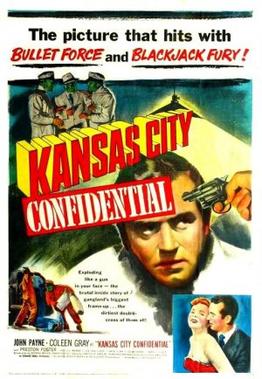

The Cast
A former song-and-dance man who pivoted to tough-guy roles in the early 1950s, Payne brings a coiled, credible physicality to the wrongly accused Rolfe. His performance anchors the film's moral center.
Coleen Gray plays the mastermind's daughter, unaware of her father's criminal activities. Her performance adds genuine warmth and moral complexity to a story otherwise populated with cold-eyed operators.
Veteran character actor Preston Foster plays the calculating ex-police captain who designs the perfect crime — a man whose procedural genius is matched only by his moral corruption.
In one of his earliest roles, the then-unknown Van Cleef delivers his trademark cool menace — a preview of the intensity he would later bring to Sergio Leone's Westerns a decade later.
Brand's imposing physical presence and weathered screen persona made him a natural fit for these morally compromised supporting roles in early '50s crime films.
The bug-eyed character actor brings his signature unease to this role, inhabiting the film's seedy underworld with characteristic unpredictability.
The Director
Philip Nathan Karlstein — known professionally as Phil Karlson — was one of the most underappreciated directors of the 1950s crime film cycle. Born in Chicago, he came up through the studio system at Universal and Columbia before breaking out with a series of brutally efficient crime films that stood apart from the era's more genteel productions.
Karlson's films were notable for their unflinching depiction of violence, institutional corruption, and the fragility of the American Dream. He favored tight, economic filmmaking: minimal sentimentality, maximum tension. Kansas City Confidential exemplifies this approach — a film that rarely pauses to breathe, propelled forward by procedural precision and a pervasive atmosphere of distrust.
Selected Filmography
- Kansas City Confidential 1952
- 99 River Street 1953
- Phenix City Story 1955
- The Brothers Rico 1957
- Walking Tall 1973
| Producer | Edward Small |
| Screenplay | George Bruce & Harry Essex |
| Story | Harold R. Greene & Rowland Brown |
| Cinematography | George E. Diskant |
| Music | Paul Sawtell |
| Editing | Buddy Small |
| Studio | Edward Small Productions |
| Distributor | United Artists |
| Running Time | 98 minutes |
| Country | United States |
| Language | English |
| Release Date | October 17, 1952 |
| Copyright Status | Public Domain |
Major Themes
The film's central conceit — criminals who never see each other's faces — expands into a meditation on how identity can be manufactured, stolen, or weaponized.
The mastermind is a former police captain — a deeply cynical commentary on corruption and the collapse of postwar social trust.
A noir staple: the ordinary man trapped by circumstance. Rolfe's victimhood forces him to become something darker to survive — a moral cost the film takes seriously.
No character in the film can trust another. The masked structure ensures mutual vulnerability — the engine of the plot's sustained tension.